Multiple Endings: Trigger Conditions and Player Path Guidance
FasesQuebra-cabeça

Multiple Endings: Trigger Conditions and Player Path Guidance

A deep dive into crafting multiple ending triggers and player path guidance systems. By quantifying core elements, we define clear completion thresholds, build a tiered hint system ranging from strong to no guidance, and design dynamic feedback to balance exploration freedom, helping developers efficiently construct multi-ending narrative structures.
Pacman City: Turning "Dodge the Ghosts" into Timed Route Planning
EsquivaQuebra-cabeça

Pacman City: Turning "Dodge the Ghosts" into Timed Route Planning

120 seconds, 3 lives, 323 dots: eat and dodge through a block-city maze, where the 8-second power-pellet reversal is the only rhythm switch that matters.

Pull the Pin: Sequential Penalties and 'Fake Difficulty'
Quebra-cabeçaFísica

Pull the Pin: Sequential Penalties and 'Fake Difficulty'

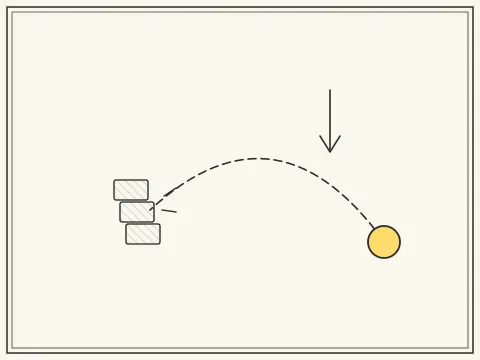
Deconstructing the penalty mechanics and fake difficulty design in pull-the-pin puzzles. The article analyzes how sequence errors trigger immediate restarts, leveraging low forgiveness to create a 'seemingly hard, actually fake' challenge experience. It reveals the underlying logic of building levels via rule-based constraints rather than complex operations, offering high-value design references for puzzle games.

8-Ball Pool: One Drag, Two Modules, and a Full Rules Engine Behind Every Shot
FísicaTiro

8-Ball Pool: One Drag, Two Modules, and a Full Rules Engine Behind Every Shot

A physics rebuild of 8-ball pool: drag distance folds into 18 power levels, all-stopped settlement keeps the rules trustworthy, and AI aim error keeps it alive.

Bubble Shooter: Aim Once, Score by the Cascade
TiroQuebra-cabeça

Bubble Shooter: Aim Once, Score by the Cascade

A bubble-shooter teardown: aim angle folds into a column pick, 8-way pops raise density, and a ceiling drop every 10 shots makes pressure countable.

Spot the Difference: Mechanics for Robust Puzzle Design
RecomendadoQuebra-cabeça

Spot the Difference: Mechanics for Robust Puzzle Design

An in-depth analysis of difference point types and distribution logic to prevent instant completions. Learn how to implement visual guidance systems that regulate scanning pace, enhance puzzle depth, and design efficient hint mechanisms that deter cheating while ensuring a compelling player experience.

One-Line Drawing: Graph Generation Algorithms and Difficulty Scaling
RecomendadoQuebra-cabeça

One-Line Drawing: Graph Generation Algorithms and Difficulty Scaling

Deep dive into the mechanics of one-line drawing puzzles: using Euler path logic to validate solvability and controlling node degrees to generate unsolvable or single-solution levels. Systematically explains how branching points and loops quantify difficulty, demonstrating how algorithms dynamically add misleading edges to boost challenge. Readers will master graph theory applications in level generation and learn to build playable, clearly tiered puzzles.

Path Planning: Balancing Pseudo-Puzzle Design and Multi-Solution Trade-offs
RecomendadoQuebra-cabeça

Path Planning: Balancing Pseudo-Puzzle Design and Multi-Solution Trade-offs

This article deconstructs pseudo-puzzle mechanics and solution space design, analyzing how to build an open solution space using limited game mechanics. It details verifiable generation techniques to maintain logical consistency while precisely balancing the fun of multi-solution exploration against the efficiency of single-solution guidance, offering developers core strategies for controlling randomness.

Página 1 de 1 · 8 posts
AnteriorPróxima