Merge / Incremental
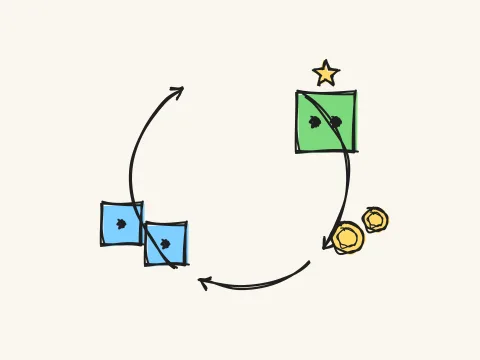
Acquire → Merge → Level Up → Higher Output
Combine two identical things into a stronger one, again and again — the fruits of Suika Game, the dragon eggs of Merge Dragons, and the villages of Triple Town all hook players this way.
You hoard low-tier units, merge a pair the moment they match, and watch output numbers double; "just one more merge and I’ll stop" — and then the sun comes up.
This is the engine of idle and progression economies — the self-reinforcing "merge → better output" loop is the most valuable structure to learn for long-term retention.
Instant Playable Demo
The Merge progression model centers on merging low‑level resources into higher‑level ones through defined rules. Players continuously acquire base units and merge them by matching type or specific recipes, unlocking higher levels, stronger abilities, or greater output. Its underlying mechanic follows an exponential or polynomial growth curve, complemented by waiting, decision‑making, and surprise. When combined with idle features, it forms the classic retention structure of offline production and online merging. A common misconception is that more merge rules increase player freedom; in reality, too many recipes can weaken macro planning, turning the game into a puzzle rather than a strategy. Conversely, limiting merge options forces deeper resource‑allocation decisions, enhancing overall strategic depth. Balancing merge speed is also key: too fast merges leave little decision space and create monotony; too slow causes boredom from waiting. The steepness of the growth curve matters too: steep curves give quick sense of achievement, but later content becomes unattainable; shallow curves keep players engaged long‑term but lack immediate feedback.
This model creates a persistent sense of progression and collection. It amplifies the "small actions → big rewards" feedback loop and, through upgrade chains, always gives players a next goal. Merge progression is ideal for hyper‑casual and mid‑casual titles, and often appears as a subsystem in management or RPG games.
Mastering the merge progression model means understanding economic curves, scarcity design, and progression psychology. Developers learn how to generate complex long‑term goals with simple merge rules, and how to avoid the "early rush, late grind" numeric pitfalls.
Core Gameplay System Breakdown
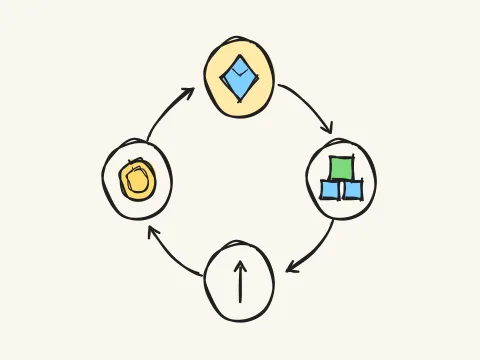
- Maintain high stickiness with low‑frequency actions (idle + timed collection)
- Provide clear long‑term goals via level progression
- Combine random drops with player choice to create surprise and strategy
- Design scalable level/merge recipe tables
- Master cost curves, production curves, and economic balance
- Implement automatic production, offline earnings, and progress persistence
- Analyze trade‑offs between merge speed and player decision time
- Base resources/units are collectible
- Same or rule‑compliant units can merge into higher levels
- Higher‑level units yield greater output or stronger abilities
- Output or new content unlocks require waiting or active action
Common Combos & Variants
Advanced Design & Algorithms (collapsed)Click to expand
- A steep growth curve makes later content feel unattainable; a shallow curve loses excitement
- Random drops without a guarantee mechanic can lead to negative experiences
- Offline earnings must be protected from exploitation; design caps or verification mechanisms
- Design of exponential/polynomial cost and production curves
- Random drop tables and pseudo‑random distributions (guarantees, pools)
- Offline progress calculation and state synchronization
// Where the scissors gap comes from: cost growth must stay below the output payoff, but not too far below
const cost = (n: number) => Math.floor(base * Math.pow(growth, n));   // 1.15^n
const output = (n: number) => Math.pow(2, n);                          // exponential output
// Tuning rule: each +0.05 on growth doubles late-game duration — do the math first