Match / Clear
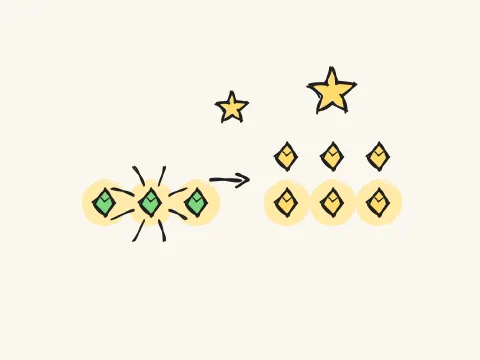
Match 3+ identical tiles in a row to clear them; refills can cascade into chains. Minimal rules, maximal juice.
Line up three or more identical tiles and they vanish. You've definitely seen this — Candy Crush, Anipop, and Sheep a Sheep are all built on it.
Each move you swap one tile to match three in a row; they clear and score, tiles above fall in to refill, and sometimes one clear cascades into another — the longer the chain, the better it feels.
The rule fits in one sentence, but "juice" and "replayability" are pure design craft — this is the best first lesson in game feedback design.
At its core, match-and-clear is a very short, trustworthy feedback loop: the player makes one swap and the rules immediately return a deterministic result. The hard part is never the clearing itself — it is the credibility of three things: invalid swaps must roll back, cascades must resolve in a fixed order, and refills must stay explainable. Player trust in the rules is built from exactly these invisible engineering details.
Match-and-clear answers a primal appetite for closure — turning a messy board into order, one small, certain, instant win at a time. Its rules are readable at a glance and its feedback is immediate, which makes it one of the rare mechanics that works across all ages and cultures.
Match-3 is one of the most proven monetization models in casual games: near-zero onboarding widens the top of the funnel, level-based structure supports endless content expansion, and move/stamina economies interlock cleanly with rewarded ads. Candy Crush's decade-long reign is no accident.
Learn match-clear and you've learned the portable craft of feedback-curve design — reward multipliers, chain pacing, difficulty ramps — knobs you'll keep turning in numbers, combat, and idle games alike.
- Beginner: understand the minimal match → clear → refill loop and reproduce one swap's full feedback in the demo
- Intermediate: write the complete resolution contract for a single swap (rollback, batched match collection, cascade order, gravity refill)
- Advanced: design deadlock detection and constrained reshuffles, and verify level health with quality metrics (legal-move count, chain depth, deadlock rate)
② Instant Playable Demo
③ Behavior System Breakdown
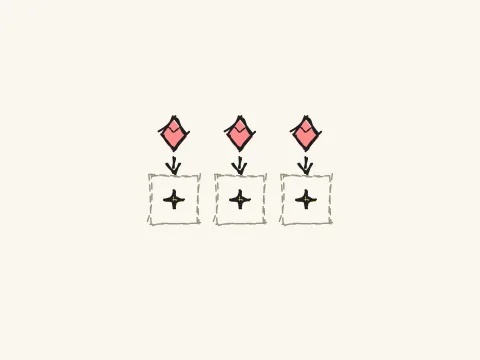
- Every move gives an instant result: matched pieces disappear, unmatched pieces don't — easy to understand even on your first try.
- Matching just 3 gets boring fast, so matching 4 or 5 pays off more, encouraging players to plan ahead instead of matching whatever is closest.
- Blockers and small goals on the board give players a reason to think about which move is worth making, instead of tapping at random.
- If the board ever has no possible match left, the game automatically reshuffles so the player is never stuck.
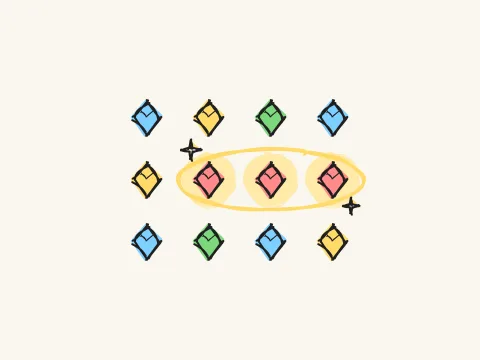
- Board and pieces: start with something simple, like a 6×6 board filled with a few colors or shapes. Three or more of the same piece in a row or column counts as a match.
- How to play: players can only swap two pieces that are next to each other. If the swap doesn't create a match, it swaps back automatically, as if nothing happened — the game never tricks the player.
- How matches clear: after a swap, find every match this move created first, then clear them all together, instead of clearing them one at a time — otherwise the result looks inconsistent.
- Falling and refilling: cleared pieces leave gaps that the pieces above fall into, and new pieces drop in from the top; then check whether the new layout happens to match again (a chain).
- What happens when stuck: if the board has no possible match left, the game must reshuffle the pieces automatically so the player always has a move to make.
④ Common Combos & Variants
⑤ Advanced Design & Algorithms (collapsed)Click to expand
- If chain rewards are too generous, players start hoping for lucky big combos instead of carefully thinking through each move: check whether players are still advancing the level objective once big chains show up — if the two keep drifting apart, the reward is winning over the strategy.
- If a level gives too few moves or too little time, players won't have time to think and will end up tapping randomly: don't judge only by clear rate — look at failed boards for a move that was actually better but missed. If the real problem is 'no time to read the board,' the issue is pacing, not difficulty.
- If new pieces are secretly stacked against the player, they'll feel like "the game is out to get me": it's fine to quietly help after a run of bad luck, but the board must never stay unsolvable, and it must never clear itself while the player does nothing.
- When several special effects happen at once, decide ahead of time which one goes first: spawn position, then whether it chains into another special tile, then area effects last — otherwise the same move can produce different results at different times, making the rules feel unreliable.
- Lowering chain rewards a little can sometimes make play more varied: once players must balance objectives, blockers, and board shape together, chains stop being the one correct answer and become just one option among several — whether to lower it should depend on whether players still advance objectives and use special tiles.
- How to find every possible match on the whole board in one pass, without missing any or checking the same spot twice: a common approach is to only re-check the two rows and columns touched by a swap, merge the hit cells into one set, then classify that set's shape as a straight line, an L/T shape, or a crossing match.
- How to tell when the board is "stuck" (no possible match left): try a temporary swap between each cell and its right and bottom neighbor and see if it would match; if any pair would, there's still a move — the same check also powers hint generation.
- How to quietly reshuffle the board when it's stuck: shuffle only the regular pieces, keep fixed level objects and locked cells in place, then verify the new layout has no immediate match and still has at least one legal move before using it.
- Keep the board's data separate from what's drawn on screen: store each cell's color, whether it's special, and whether it's locked in one place, rather than reading the rendered picture — this is what makes reshuffling, replay, and testing reliable.
- One match can trigger several rounds in a row (a chain): work out what each round clears, how many points it adds, and whether it spawns a special tile before updating the board, instead of changing the board bit by bit — that keeps the outcome from depending on processing order.
- If you want to seriously tune this ruleset, track over time: legal-move count, deadlock rate, invalid-swap rate, average chain depth, and how often 4/5-matches occur — compare settings on the same level to see whether a change actually helped.