Merge Units
Merge same-level units to upgrade, leveraging exponential growth for long-term objectives; the core lies in recipes, output curves, and full-cell handling.
Drag two identical pieces together and they merge into a higher-tier one — 2048, Suika Game, and Merge Dragons are all built on this.
You stack matching pieces and watch them pop into a bigger one; the grid keeps filling up while you juggle space and chase the next tier — simple, but impossible to put down.
The pull of exponential growth is nowhere clearer than here — if you want to learn how to give players a long-term goal, merging is the best specimen to dissect.
Merge play is a self-reinforcing growth engine: same-level merging converts low-frequency actions into deterministic tier jumps, and an exponential output curve keeps "the next tier" forever more valuable than "this one." The hard part is not the merge rule — it is three loop-closing details: a full grid must always have an escape that never deadlocks, the feed rhythm must leave a thinking budget, and the level cap decides how far the pull reaches. The "just one more merge" addiction comes from the curve shape, not the art.
Merging feeds the twin instincts of collecting and growing stronger: low-tier units are visible savings, and every merge is a certain upgrade — the goal chain is always clear, and the next tier is always beckoning.
Merge is a dual winner of retention and monetization in casual games: the goal chain natively supports content expansion (a new tier IS new content), and grid pressure interlocks cleanly with stamina and booster monetization — proven repeatedly from Merge Dragons to Suika Game.
Learn merging and you learn exponential pull-curve design — escalating output, cap placement, feed pacing — a numeric structure that holds just as well in idle games and card collection.
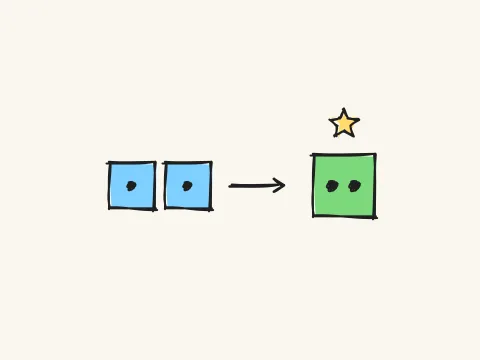
- Beginner: understand the minimal loop — feed → same-level merge → level up → higher output — and reproduce one merge and one full-grid handling in the demo
- Intermediate: write the full merge-rule contract (same-level judgment, recipe table, full-grid policy) and tune the cost/output curve to control the growth rhythm
- Advanced: design pity and anti-farming mechanics, and verify board health with full-grid rate, average merge interval, and tier distribution
② Instant Playable Demo
③ Behavior System Breakdown
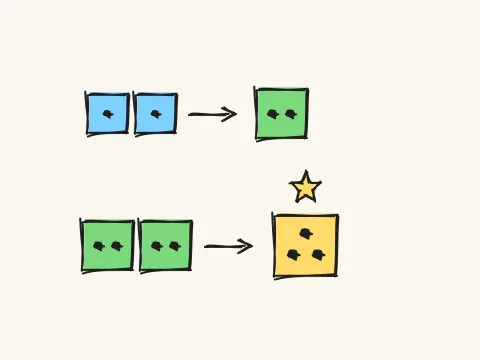
- Transform low-frequency actions into clear long-term goals via merge-and-upgrade.
- Maintain continuous pull toward the next level with an exponential growth curve.
- Ensure the board remains playable through full-cell or unmergeable handling.
- Same-level merge rule: at least two units of the same level merge into one unit of level +1; if the target cell is already full after merging, trigger full-cell handling.
- Output growth: each unit's output increases with level, starting at 1 for the lowest level and up to 10 for the highest, forming an exponential curve.
- Full-cell handling: when a target cell is full and cannot merge, the system alerts and blocks placement; if the player opts to force placement, the system automatically consumes low-level units to free space.
- Recipe restriction: same-level merging only applies when the recipe table (e.g., 2→1, 3→1) is satisfied; units not listed in the recipe cannot merge.
④ Common Combos & Variants
⑤ Advanced Design & Algorithms (collapsed)Click to expand
- A steep output curve can make later levels unattainable, while a shallow curve loses momentum; balancing the exponential growth rate is a core tuning point.
- Missing full-cell handling can freeze the board; forcing consumption of low-level units keeps flow but diminishes their value.
- High output from low-level units can provide abundant early resources, sometimes more important than high-level units—counterintuitive, so early resource allocation must be considered.
- Random drops lacking a safety net amplify frustration; a guarantee and anti-spam mechanism are needed.
- Merge determination: same-level matching, recipe table, chain merge settlement.
- Growth curve: exponential/segmented cost and output design, guarantee and anti-spam.