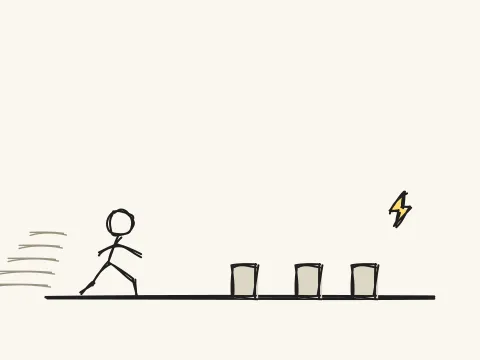
Runner
Continuously moving forward while managing path, obstacles, and rhythm; core is readability and choice cost.
Your character runs forward automatically while you dodge, jump, and slide — Temple Run and Subway Surfers are built on this.
The screen scrolls nonstop as you switch lanes and jump at the last moment; the speed keeps climbing and your palms start sweating — every second asks "how much longer can you last?"
It makes "difficulty ramping" tangible — if you want to learn how to raise tension without scaring off beginners, the runner is the standard answer.
Runner play packs difficulty into the time dimension: auto-forward motion turns every second into a decision deadline, so the speed curve IS the difficulty curve. The hard part is not obstacle placement — it is readability engineering: obstacle lead time decides whether a player fails a decision or fails a reaction, and camera plus speed together set the information density. Behind every "this game is fair" review is a precise ratio of lead time to speed.
Runners satisfy the primal urge of forward motion: obstacles keep coming, you keep dodging, and the distance itself is the progress bar — simple, tense, and you always want to know how far you can go.
The runner is the industrialized template of hyper-casual: minimal mechanics, content that scales infinitely through parameters, and one of the most proven ad-monetization funnels in the business.
Learn runners and you learn rhythm-and-readability engineering: how speed curves ramp, how much obstacle lead time to give, how to arrange difficulty breathing — this "timeline typesetting" skill is just as central in level design and boss fights.
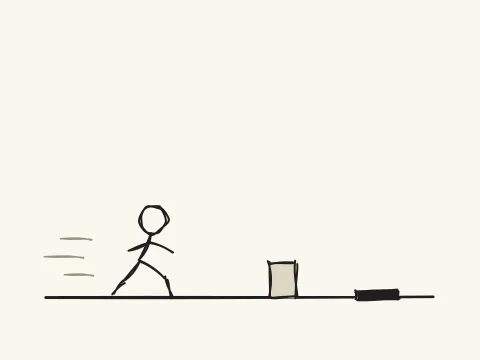
- Beginner: understand the minimal loop — auto-forward → obstacle appears → input → judge → speed change — and reproduce a lane-switch dodge in the demo
- Intermediate: write the obstacle-readability contract (lead time, lane spacing, segment rhythm) and shape difficulty with initial speed plus acceleration curve
- Advanced: design segment structure with peaks and valleys (difficulty breathing) and verify level pacing with misread rate, survival curve, and per-segment pass rate
② Instant Playable Demo
③ Behavior System Breakdown
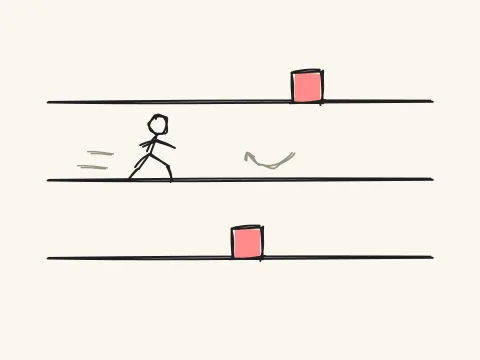
- Use minimal input to create multiple branching choices (lane/jump/turn/branch).
- Standardize obstacle readability and advance notice, reducing "can't see, then die".
- Use speed and segment structure to create rhythmic peaks and troughs, avoiding monotonous straight lines.
- Forward speed: base 5 m/s, combo bonus +0.5 m/s per combo, max 8 m/s.
- Obstacle judgement: jump pass requires triggering jump within 0.3 s before obstacle, jump height ≥1.2 m; slide pass requires sliding within 0.2 s before obstacle; turn pass requires completing turn when lane spacing ≥1.5 m.
- Reward system: collecting items increases combo +1; combo ≥5 triggers combo bonus 1.2× speed; combo lasts 10 s.
④ Common Combos & Variants
⑤ Advanced Design & Algorithms (collapsed)Click to expand
- Insufficient readability leads to "reaction failure" rather than "decision failure", causing players to lose rhythm.
- Too high obstacle density overwhelms choices, turning the game into pure reaction and reducing depth.
- Too low obstacle advance time can actually increase rhythm, but also raises misjudgement rates because players must decide faster, leading to over-anticipation and delayed reaction.
- Level: segment stitching, difficulty rhythm arrangement.
- Judgement: terrain collision, jump trajectory, camera follow.