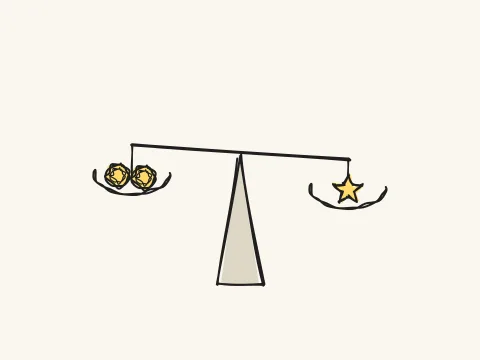
Choice / Strategy
Make critical choices under constraints of information and resources; the core is the presentation of information and the explainability of consequences.
Each round offers you a few options — pick one and live with the consequences. Card battlers, auto-chess, and Clash Royale-style tactical choices are built on this.
Three rewards sit in front of you, each tempting and each with a price; you weigh them forever, pick one, and rounds later that choice starts paying off — or biting back.
"Meaningful choice" is the soul of strategy games — fake choices, information volume, and consequence explanation are all laid bare here.
Choice-based strategy wraps "randomness" as "governable fate": options are limited and consequences traceable, so players believe outcomes were chosen by themselves. The hard part is not the number of options — it is the explainability of their differences: converging payoffs degenerate into fake choices, too much information causes decision fatigue, too little turns play into guessing. The player’s sense of "strategy" rests on being able to replay and trace every choice afterward.
Choice-driven strategy satisfies the illusion — and reality — of "fate in my hands": every round’s choice is traceable and reviewable. Wins and losses are not luck; they are my judgment.
Decision-driven play is the most content-efficient structure: a few options can carry a whole run’s depth, and deck-builders and auto-battlers have proven its friendliness to small teams — with the right mechanics, content costs stay far below action games.
Learn choice-driven strategy and you learn decision-density design: option differences, information ratios, explainable consequences — a craft that ports directly to roguelike drafting, narrative branches, and even product pricing experiments.

- Beginner: understand the decision loop — options presented → choose → cost & payoff → situation updates — and reproduce one pick-of-three in the demo
- Intermediate: write the option-generation and consequence-settlement contract (payoff magnitude, reroll cost, info refresh rate), and learn to spot fake choices
- Advanced: design information-disclosure ratios and risk visualization, and verify decision quality with option-pick distribution and per-option win-rate gaps
② Instant Playable Demo
③ Behavior System Breakdown
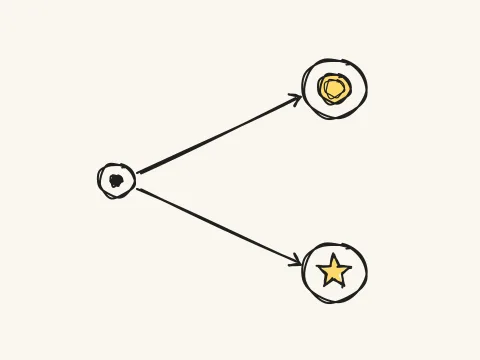
- Eliminate 'pseudo-choices' caused by insufficient option differentiation.
- Balance information disclosure and randomness to avoid pure guessing or pure arithmetic.
- Support strategic depth through rounds and resource curves, preventing one-click endings.
- Control information volume to prevent decision fatigue and excessive guessing.
- Limit resources to increase strategic depth, avoiding shallow decisions caused by excess resources.
- Balance the proportion of hidden information and number of visible options to enhance the player's ability to explain consequences.
- Information: number of visible options ≤ 3, proportion of hidden information ≤ 30%.
- Resources: available resource amount per round ≤ 2, and no more than 2 resource types.
- Consequences: state changes (rewards/punishments) resulting from each choice must be traceable and explainable, and the magnitude of change ≤ 20% of current resources.
- Decision cost: each choice consumes a fixed cost, with cost-to-reward ratio ≤ 1:1; high cost limits choice frequency, increasing depth; low cost increases frequency, reducing depth.
- Information update frequency: information updated per round ≤ 1/3 of current visible options; frequent updates increase adaptability, reducing planning depth; sparse updates increase planning depth, reducing adaptability.
- A moderate proportion of hidden information can improve decision quality; too low leads to overanalysis, too high leads to decision fatigue.
④ Common Combos & Variants
⑤ Advanced Design & Algorithms (collapsed)Click to expand
- Insufficient option differentiation can lead to 'pseudo-choices'.
- Unexplained consequences prevent players from learning and improving.
- Excessive information fatigues newcomers; too little turns it into guessing.
- Excessive randomization weakens the player's sense of strategic control.
- Events: event pool and weights, guaranteed events, and deduplication.
- Economy: resource curves, inflation control, threshold design.