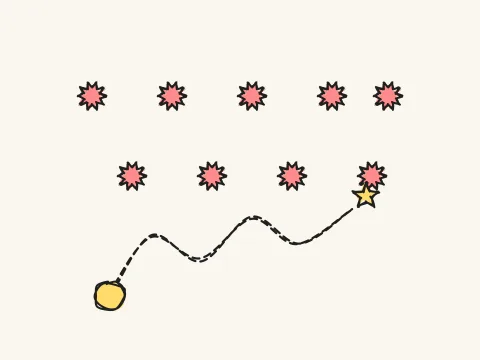
Dodge / Avoid
Survive under continuous pressure and spatial constraints; the core revolves around hit detection, windows, and rhythm.
Hazards keep flying at you and your job is to stay alive — bullet-hell shooters, Flappy Bird, and dodgeball-style games are all built on this.
You drag your character through a storm of bullets, weaving between them; the split second where one grazes past without killing you makes your heart skip — that "so close" thrill is the signature move.
It is the purest sample of "difficulty as rhythm" — if you want to learn how to make players tense without feeling cheated, start here.
Dodge play breaks "survival" into a chain of readable, moment-to-moment judgments: every hazard has a telegraph, a trajectory, and a hitbox, and every dodge immediately reports its outcome and its reason. The hard part is not the dodging — it is the credibility and forgiveness of the judgment: the gap between hitbox and visual circle is your thrill budget, and invincibility frames plus graze feedback decide whether a failure is learnable. The fairness players feel is built from these invisible judgment-engine details.
Dodging feeds a safe craving for danger — a bullet grazing past without killing you gets converted by the brain into pure thrill. Forgiveness windows and graze bonuses mass-produce that moment, letting players harvest small wins swinging between "I almost died" and "I can’t believe I didn’t."
Bullet-dodging is one of the lowest-barrier forms in action gaming: one finger, ten seconds a run, naturally suited to fragmented time and short-video sharing.
Learn dodge play and you learn pressure-curve and forgiveness engineering — density ramps, hitbox scaling, telegraph lead time — knobs you will keep turning in runners, shooters, and boss fights.
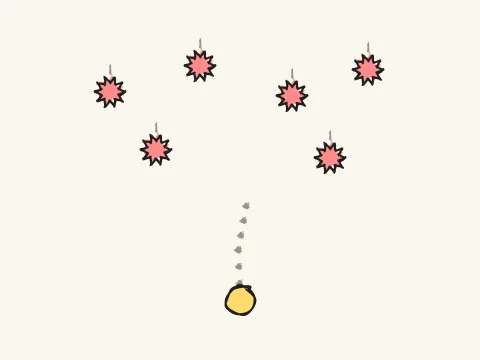
- Beginner: understand the minimal survival loop — spawn → telegraph → move → judge → feedback — and reproduce one graze judgment in the demo
- Intermediate: write the full hit-judgment contract (hitbox, graze zone, invincibility frames, respawn protection) and tune forgiveness parameters that keep beginners from churning
- Advanced: design the pressure curve (density × speed × time ramp structure) and verify difficulty health with graze rate and survival-time distribution
② Instant Playable Demo
③ Behavior System Breakdown
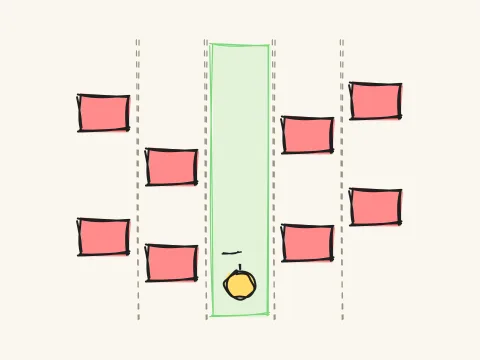
- Make failure reasons attributable (why you were hit, where safety lies)
- Turn near misses into satisfying moments rather than just staying alive
- Control intensity with a pressure curve (density/velocity/rhythm) to avoid pure numeric stacking
- Hazard: Generation rules (frequency/direction/speed/quantity)
- Movement: Player movement and constraints (speed, turning, boundaries)
- Hit detection: Hit radius and resolution (damage/failure/Invincibility frames)
④ Common Combos & Variants
⑤ Advanced Design & Algorithms (collapsed)Click to expand
- Unclear warnings make failures unaccountable (players feel unjustified)
- Too fast speed with weak feedback turns the experience into 'passively getting hit'
- Overly strict hit detection compresses expressive space; overly lenient loses tension
- Generation: Bullet/obstacle generator and difficulty curve
- Hit detection: Circle/capsule collision, near-miss detection, invincibility frame window