Combat
Centered on trading and countering with opponents and skills; the core revolves around windows, resources, and reading moves.
Trade blows with an opponent up close — when your health bar empties, you lose. Fighting games and action-game boss fights are built on this.
You read the opponent’s wind-up, strike into the gap; when stamina runs dry you retreat while gasping — every hit lands with weight, every block is a held breath.
An introductory dissection of "the dueling feel" — once windows, resources, and move-reading click, every confrontation design has its skeleton.
Combat play translates "conflict" into readable exchanges: attacks have wind-ups, defenses have windows, resources have budgets — every strike settles risk against reward on the spot. The hard part is not the move count — it is the explainability of the exchange: unclear wind-ups kill counterplay, too-fast resource regen turns skills into mindless loops, and missing hit-stun robs impacts of weight. Players feel "that was a fair fight" because wins and losses both trace back to specific reads and choices.
Combat satisfies the deep pleasure of reading an opponent: wind-ups, hit-stun, and resource exchanges turn every victory into intellectual evidence — you know exactly where you won.
Adversarial depth is the root niche of the action category: from side-scrollers to fighting esports, combat systems are the longest-lived content — a great combat system keeps players studying it for years, and that study itself becomes community and traffic.
Learn combat and you learn readable-bout design: the window/resource/read triad reappears in different forms across shooters, card games, and auto-battlers.
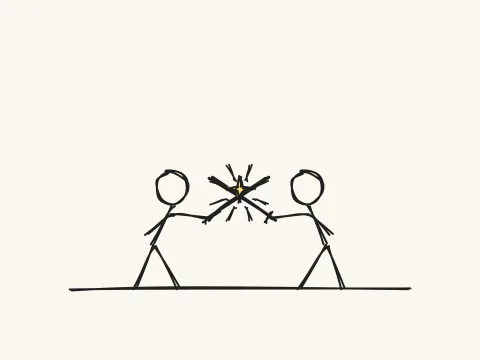
- Beginner: understand the attack/defense loop — observe → strike → judge → feedback → resource regen — and reproduce one attack and one block in the demo
- Intermediate: write the window contract (wind-up / block window / hit-stun) and the resource contract (stamina/cooldown spend and regen)
- Advanced: design move-counter relationships and counterplay space, and verify balance with exchange ratio, block rate, and mash frequency
② Instant Playable Demo
③ Behavior System Breakdown
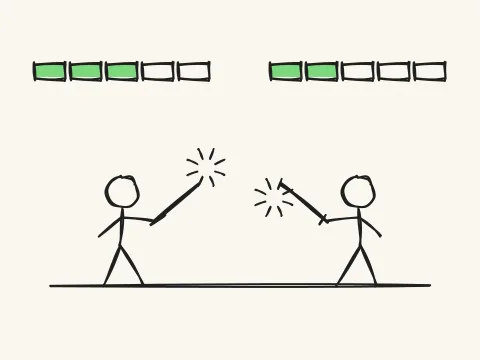
- Clarify attack/defense windows (wind-up/active/stagger) to reduce 'unfair hits'.
- Use resources (stamina/cooldown/distance) to constrain skill usage, forcing choices and rhythm.
- Balance hit weight and risk/reward so that 'attack/evade/block' each carry value.
- Balance wind‑up length and rhythm: a too‑short wind‑up allows combos but removes counter windows; a too‑long wind‑up is easy to interrupt but allows move reading. Designers must balance combo fluidity with defensive readability.
- Resource recovery speed versus skill variety: too fast recovery leads to mindless skill loops; too slow limits combo depth, increasing strategic depth.
- Actions: the player may choose to attack, block, or move; attacks require a wind‑up window; movement requires a movement window.
- Resolution: hit chance is based on accuracy + opponent's evasion; if accuracy > evasion, it's a hit; block chance is based on block rate + opponent's attack power; if block rate > attack power, it's a block.
- Invincibility check: if a skill's invincibility frames exceed the opponent's action duration, the opponent cannot be hit.
- Resources: stamina/cooldown; attacks consume stamina/cooldown; movement consumes stamina; blocking consumes stamina.
- Windows: wind‑up, block window, movement window, stagger window; each window length is configurable.
④ Common Combos & Variants
⑤ Advanced Design & Algorithms (collapsed)Click to expand
- Unclear wind‑ups render counters ineffective, turning combat into a numbers game.
- Too fast resource recovery leads to mindless skill loops.
- Missing stagger/recoil removes weight from hits.
- Shorter wind‑ups increase overall pace but may shrink defensive space, forcing players into passive attacks and counterintuitively lowering the experience.
- State Machine: skill states, cancellation, stagger, hit
- Hit Detection: colliders, invincibility frames, combo windows