Simulation
Generate observable world behavior via system rules; the core is variables, causal chains, and explainability.
Set the rule parameters and watch a little world run itself — management sims, city builders, and The Sims are built on this.
You nudge the tax rate; the next day money is up but the people are unhappy; nudge it again and the population starts draining — every knob pulls the whole web, and watching the system react is more addictive than direct control.
A training ground for "systems thinking" — causal chains, emergence, and steady states, all mystical-sounding concepts you can actually touch here.
Simulation play lets the rules tell the story themselves: players do not operate outcomes directly — they adjust variables and watch causal chains propagate into emergent behavior. The hard part is not the variable count — it is explainability and steady states: too many variables and causality becomes unreadable, too few and the system lacks depth, and both runaway collapse and stagnant boredom are simulation failures. Players say "this system is fascinating" because every adjustment can be explained by its causal chain.
Simulation satisfies the god-view urge for control: you play no one — you set the rules and watch a world grow itself. Understanding a system is more addictive than winning a fight.
Simulation is a rare training ground for systems thinking: city builders and management sims let players experience causal chains and emergence hands-on in a safe sandbox — a capability that spills over into real-world decisions. That is also why it is the natural niche for educational and serious games.
Learn simulation and you learn systems design with variables and feedback loops — update rules, propagation delays, steady-state boundaries — thinking that ports directly into economy systems, ecosystem balance, and even product growth models.

- Beginner: understand the simulation loop — set variables → system evolves → observe metrics → adjust — and reproduce one parameter intervention in the demo
- Intermediate: write the variable and causal-chain contract (update rules, propagation delays, boundary conditions), and tune the feedback-period length
- Advanced: design steady states and collapse boundaries (explainable emergence), and verify system vitality with metric variance, collapse rate, and intervention effectiveness
② Instant Playable Demo
③ Behavior System Breakdown
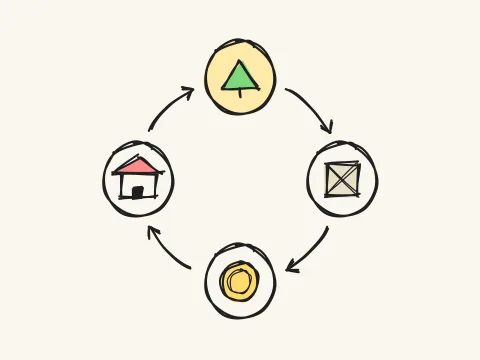
- Make causal chains observable and explainable, avoiding 'black-box number crunching'.
- Provide steady states and boundary conditions to prevent system runaway or boring stagnation.
- Give players clear intervention levers (parameters/strategies/resources) so adjustments are effective.
- Variables: 2–4 key variables (minimum 2).
- Evolution: Update rules (every tick/turn).
- Observation: Let players see key metric changes.
④ Common Combos & Variants
⑤ Advanced Design & Algorithms (collapsed)Click to expand
- Too many variables reduce explainability; too few variables reduce depth.
- Long feedback cycles cause players to lose immediate feedback; short cycles cause excessive system noise.
- Overly restricting parameters can spur players to find micro-tuning points, producing richer emergent behavior—limits force exploration of edge states.
- Evolution: tick updates, event queue, stability control.
- Visualization: metric dashboard, heatmap, replay.