Physics
Create gameplay using physics rules and predictability; the core is explainability and controllability.
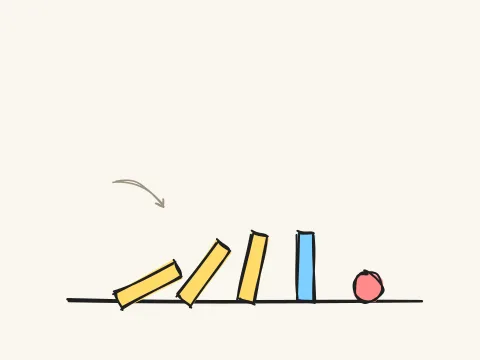
Things roll, collide, and topple under real physics rules, and you harness them to win — Angry Birds, Cut the Rope, and Crayon Physics are built on this.
You cut one rope and watch the block sway, fall, and crush the target; when the physical chain reaction lands in one go, that "exactly as planned" rush is unmatched.
It teaches "predictable chaos" — anyone can wire up a physics engine, but making it "fair and fun" is all parameter and stability craftsmanship.
Physics play trades deterministic simulation for the player’s intuitive trust: the same input must produce the same result, or no one dares to plan precise moves. The hard part is not the engine — it is feel parameters and stability engineering: friction, elasticity, and damping set the motion rhythm, while tunneling and jitter set credibility, and the cut/demolish budget turns a sandbox into a puzzle. When players say "this physics feels real," they mean "I can predict it."
Physics play rewards the player with the "just as I predicted" hit: when blocks topple exactly the way you imagined, it is a small proof of how the world works — a satisfaction found nowhere else.
Physics puzzlers are a classic breakout niche for small teams: engines are off-the-shelf and levels are content — Angry Birds and Cut the Rope both proved its commercial viability.
Learn physics play and you learn the hard craft of stability engineering: determinism of same-input-same-result, performance budgets, parameter feel tuning — core engineering literacy for any real-time system, and the most portable inner skill beyond physics itself.
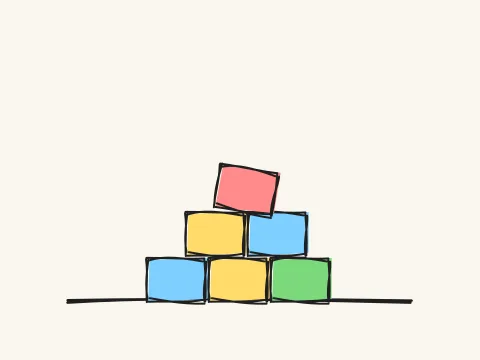
- Beginner: understand the physics loop — apply force/drag → motion & collision → judgment → feedback → reset — and reproduce one cut and collapse in the demo
- Intermediate: write the stability contract (continuous collision detection, iteration counts, sleep thresholds) and shape feel with friction/elasticity/damping
- Advanced: design the action budget and a reproducible solution space, and verify physics credibility with jitter rate, tunneling rate, and reset cost
② Instant Playable Demo
③ Behavior System Breakdown
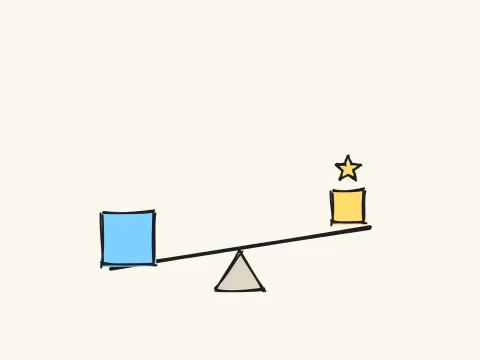
- Make physics outcomes predictable and learnable (same input yields consistent results)
- Maintain stable simulation within performance budgets, reducing jitter, penetration, and other experience-breaking issues
- Allow tactile parameters (friction, elasticity, damping) to be adjustable and verifiable for rapid iteration
- Force: Use RigidBody.AddForce(F), e.g., F=10N, direction arbitrary.
- Velocity: Set RigidBody.velocity = v, e.g., v=5m/s.
- Gravity: Use default g=9.8m/s², or adjust via RigidBody.gravityScale.
- Collision: Add a Collider (AABB/circle/polygon) to objects, enable Continuous Collision Detection (CCD) to prevent penetration.
- Goal: Determine arrival/contact/holding via triggers or state machines; the minimal condition is arrival.
④ Common Combos & Variants
⑤ Advanced Design & Algorithms (collapsed)Click to expand
- Excessive friction limits object movement; too little friction causes unstable motion and uncontrolled sliding—balancing friction is key to predictable movement.
- High elasticity retains too much energy, causing excessive rebounds; low elasticity dissipates energy quickly, leading to stalling—reasonable elasticity controls motion rhythm.
- Excessive damping stops objects too quickly; insufficient damping prolongs motion and can cause oscillation—moderate damping achieves smooth stops.
- High-mass objects accelerate less under the same force, moving slower but penetrating less; low-mass objects accelerate more, risking penetration or overly fast motion.
- Collision: AABB/circle/polygon, Continuous Collision Detection (CCD)
- Stability: Time step, damping, constraint solving