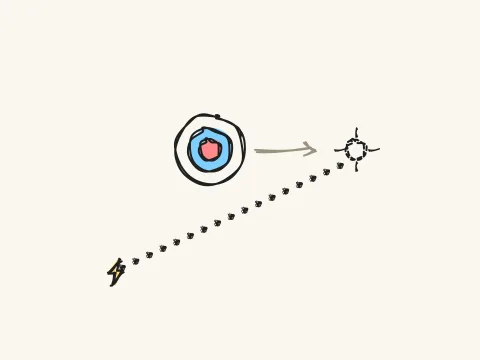
Shoot / Aim
Aiming, hitting, and resource management create a closed loop; the core lies in hit feedback and risk-reward.
Aim at the target and fire — hits score, ammo is limited. Shooters, target-range games, and FPS titles are all built on this.
The reticle settles on a target, you squeeze the trigger, and the hit feedback bursts; when the mag runs dry you scramble to reload — lose the rhythm for a second and targets pile up into a mountain.
"How juice gets manufactured" is nowhere more visible than in shooting — hit feedback, ammo constraints, and risk-reward are required courses in feedback design.
Shooting play is an extremely short reward loop: aim, fire, hit judgment, feedback burst — every trigger pull is an evaluable micro-decision. The hard part is not the hit — it is the explainability of constraints: ammo and cooldowns turn infinite output into rhythm management, while spread and recoil turn "firing a lot" into "firing well." A gun "feels good in the hand" when the reason behind every hit and every miss is clearly visible.
Shooting satisfies the instant-adjudication urge of "a hit is justice": reticle on, trigger pulled, target down — reward and punishment cash out in milliseconds, the most immediate thrill loop there is.
Shooting is one of the largest category niches in the industry: from target ranges to FPS esports, the precision of hit feedback sets the product floor, and feel-tuning capability is a team’s core asset.
Learn shooting and you learn feedback-precision engineering: judgment credibility, ammo pacing, the instant burst of a hit — this fine control over "feel" transfers to any mechanic that needs actions to carry weight.
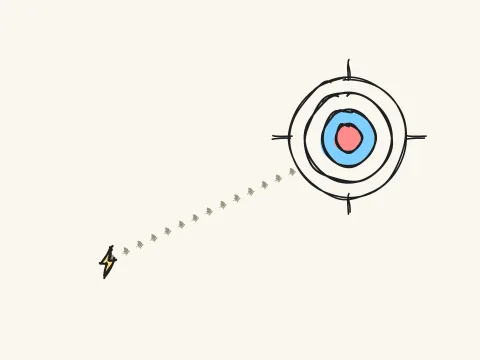
- Beginner: understand the minimal loop — aim → fire → hit judgment → feedback → cooldown/reload — and reproduce one hit and one reload in the demo
- Intermediate: write the trajectory and occlusion contract (hit judgment, spread model, ammo economy) and shape handling difficulty with fire rate and recoil
- Advanced: design target-spawn rhythm and pressure curves, and verify shooting feel with accuracy distribution and reload-timing distribution
② Instant Playable Demo
③ Behavior System Breakdown
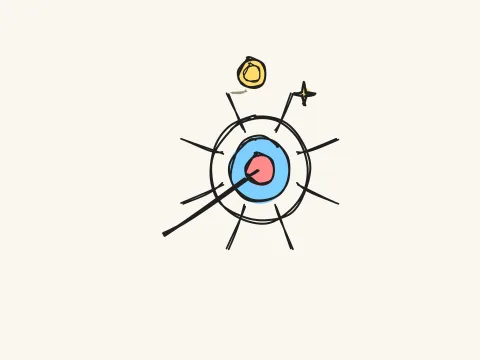
- Turn hit detection and feedback into a learnable rhythmic window (why hitting feels good).
- Use constraints like ammo, recoil, and spread to control erratic shots and unlimited output.
- Make pressure come from interpretable targets and rhythm, not just monster stacking.
- Balancing ammo limits and output: too much ammo leads to overkill and lack of rhythm; too little ammo forces frequent reloading, breaking combo flow.
- Balancing recoil and accuracy: excessive recoil makes shooting unstable and reduces combos; weak recoil makes players too precise, diminishing challenge.
- Overly precise shooting weakens game rhythm: when players can easily hit all targets, the game loses tension and players may stop actively seeking dodge or strategy.
- Aiming: mouse/joystick/touch pointing (minimum: fixed direction).
- Hit: ray or projectile detection and occlusion.
- Resources: ammo/cooldown/energy (minimum: cooldown).
④ Common Combos & Variants
⑤ Advanced Design & Algorithms (collapsed)Click to expand
- Weak hit feedback makes shooting feel like 'air shots'.
- Unexplained recoil and spread break the learning curve.
- Inconsistent occlusion rules cause strong frustration.
- Hit detection: rays/projectiles, collision layers, hitboxes.
- Spawn generation: enemy refresh rhythm and wave design.